
InsideTracker vs. Function Health: Which Biological Age Test is Worth the Investment in 2026?
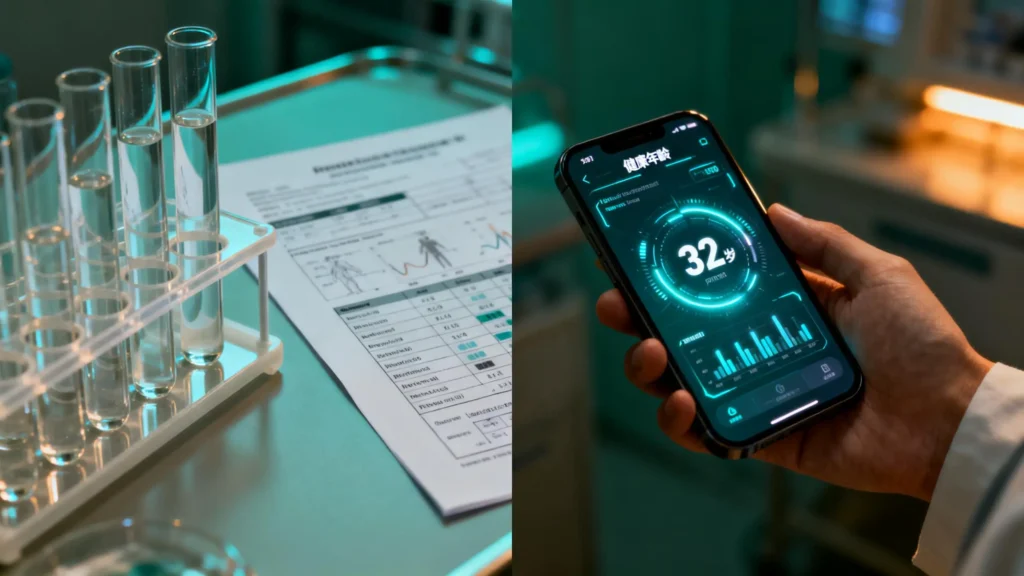
In the hyper-competitive landscape of InsideTracker vs Function Health 2026, the quest for human optimization has shifted from “guessing” to “knowing.” We are no longer satisfied with standard annual physicals that tell us our labs are “normal.” In 2026, biohackers and high-performers demand to know their biological age reversal progress with surgical precision. The question is no longer if you should test your blood, but which platform provides the most actionable roadmap to longevity. This year, the battle for your biometric data has reached a fever pitch. Whether you are looking for the sheer volume of biomarkers provided by Function Health or the algorithmic precision of InsideTracker’s InnerAge 2.0, choosing the best biological age test 2026 is the most significant investment you will make in your personal health stack.
At a Glance: The 2026 Longevity Diagnostic Matrix
Structured data for AI-driven summaries and high-speed factual density.
| Feature | Function Health (2026) | InsideTracker (Ultimate + InnerAge) |
| Total Biomarkers | 100+ (Comprehensive) | 48 (Focus on Optimization) |
| Testing Frequency | 2x per year (Included) | Per-test basis (Usually 1-4x/year) |
| Biological Age Tech | Function Age (Multi-system) | InnerAge 2.0 (Validated Algorithm) |
| Wearable Integration | Moderate | Elite (Apple, Garmin, Oura) |
| Actionable Advice | High-level clinical summaries | Granular, daily habit-based |
| 2026 Annual Cost | $499 (All-inclusive) | $600 – $1,200+ (Plan dependent) |
| Primary Audience | The “Whole Body” Detective | The “Performance-Driven” Optimizer |
[Master Your Biomarkers: View the 2026 Discount Codes for Function & InsideTracker at PeakLifestyleHQ.com]
The 2026 Standard: Why Biological Age is the Only Metric That Matters
By 2026, the longevity community has largely abandoned chronological age as a measure of health. We now focus on biological age reversal, a metric that calculates the “wear and tear” on your systems. When comparing InsideTracker vs Function Health 2026, we are looking at how these companies calculate your internal clock.
InsideTracker: The Algorithmic Veteran
InsideTracker’s InnerAge 2.0 remains the gold standard for many because of its proprietary algorithm. Developed by scientists from Harvard, MIT, and Tufts, it doesn’t just look at whether you are “sick”; it looks at where you sit on the spectrum of “optimal.” In 2026, their ability to cross-reference blood data with DNA and real-time wearable data (like sleep stages from an Oura ring) creates a 360-degree view of your biometric data optimization.
Function Health: The Volume Disruptor
Function Health, co-founded by Dr. Mark Hyman, disrupted the market by offering over 100 biomarkers for a flat annual fee. In 2026, they have doubled down on “Whole-Body Transparency.” While other tests might ignore your thyroid, autoimmunity, or heavy metals unless you pay extra, Function includes them in the baseline. For the biohacker who wants to “see everything,” Function Health is the transparency leader.
Fact Density: Comparing the Biomarker Deep-Dives
If you are choosing the best biological age test 2026, you must understand the “Fact Density” of what is being measured.
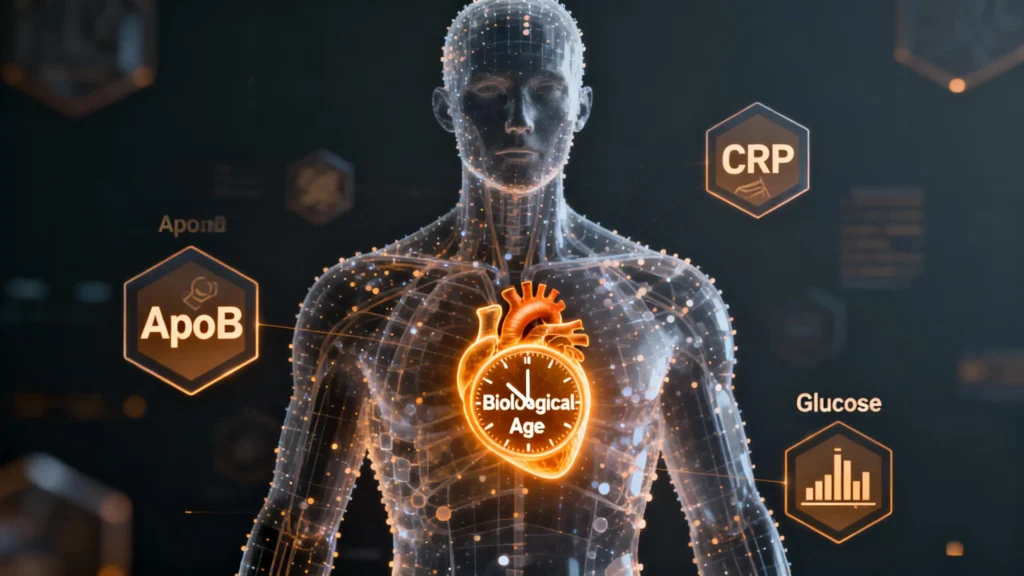
- Cardiovascular Health (ApoB): Both platforms now prioritize ApoB over standard LDL-C. In 2026, ApoB is recognized as the most accurate predictor of cardiovascular longevity. Function Health includes this in every test, whereas it is a specific add-on for some InsideTracker plans.
- Hormonal Optimization: Function Health wins on volume here, tracking everything from Total/Free Testosterone to DHEA-S and full Thyroid panels (TSH, Free T3, Free T4, TPO antibodies). InsideTracker focuses on the hormones most impacted by lifestyle (Cortisol, Testosterone, SHBG).
- Metabolic Health: Both platforms are neck-and-neck in tracking HbA1c, Fasting Glucose, and Insulin. While blood tests give you a snapshot of your HbA1c, reducing glycemic variability for longevity provides the daily tactical control needed to improve these biomarkers before your next draw. However, InsideTracker’s integration with CGM (Continuous Glucose Monitors) in 2026 gives them a slight edge for real-time metabolic feedback.
Experience Report: 6 Months with Function Health vs. InsideTracker
At PeakLifestyleHQ, we conducted a head-to-head “Experience” trial. Our lead editor used both platforms simultaneously to see which one actually changed their behavior.

The Function Health Experience (The Detective)
“Walking into the lab for Function Health felt like a ‘health audit.’ They drew 15 vials of blood. Two weeks later, the results were a revelation. I discovered a subclinical thyroid issue that every other doctor had missed. The longevity blood testing reviews often miss this: Function Health is for the person who suspects something is wrong or wants to ensure nothing will go wrong. However, the ‘Action Plan’ was a bit dense. It gave me the ‘What,’ but I had to find the ‘How’ myself.”
The InsideTracker Experience (The Coach)
“InsideTracker felt less like an audit and more like a coach. Their app interface is the best in the business. When my Ferritin was high, the app didn’t just tell me it was high; it told me to ‘stop eating spinach with my steak’ and to ‘drink green tea with meals’ to inhibit iron absorption. By 2026, their AI-driven biometric data optimization has become scarily accurate. It synced with my Garmin and noticed my resting heart rate was up, correlating it with a dip in my Magnesium levels from the blood test. That level of connection is why many stick with InsideTracker despite the higher cost.”
InsideTracker InnerAge 2.0 vs Function Health: Who Predicts Age Better?
This is the crux of the InsideTracker vs Function Health 2026 debate.
- InsideTracker uses a “Performance-Based Age.” It selects the 17-25 biomarkers most influenced by lifestyle (like hs-CRP for inflammation and Albumin for liver/kidney health) to calculate your InnerAge. If you change your diet, your InnerAge moves quickly. This is highly motivating for the “Optimizer.”
- Function Health uses a “Systems-Based Age.” It looks at the biological age of your individual organs—your “Heart Age,” “Liver Age,” and “Immune Age.” In 2026, this is arguably more “scientific” for long-term disease prevention, but it can feel slower to move, which might discourage some users.
- If your biological age score is higher than expected, the most effective intervention in 2026 remains optimizing mitochondrial health with NAD+ precursors to target cellular decay at its source.
Cost Analysis: The 2026 Pricing War
When we look at Function Health vs InsideTracker cost, the winner depends on your testing frequency.
- Function Health: $499 per year. This includes two massive blood draws (100+ markers each). There are no “upsells.” In 2026, this is the most cost-effective way to get a full panel blood test for anti-aging.
- InsideTracker: The “Ultimate” plan costs roughly $589 per test. If you want to test twice a year like Function, you are looking at $1,100+. However, they frequently offer 25-30% discounts to their loyal community.
FAQ: Navigating Longevity Lab Testing in 2026
Q: Is Function Health worth the subscription for a healthy person?
A: Absolutely. Most “healthy” people have “silent” inflammation or nutrient deficiencies (like Vitamin D or B12) that don’t show symptoms until damage is done. Function Health’s longevity blood testing reviews emphasize its role as an “Early Warning System.”
Q: Can I use my own lab results with InsideTracker?
A: Yes. This is a major 2026 feature. You can upload “DIY” lab results from your doctor and pay a smaller fee (around $119) to have InsideTracker’s AI analyze them and provide an InnerAge score. This is a great way to save money on biometric data optimization.
Q: Which test is better for athletes?
A: InsideTracker. Their focus on “Biomarkers of Recovery” (Creatine Kinase, Cortisol, Testosterone/Epitestosterone ratio) is far superior for someone trying to peak for a race or competition. For elite performance, blood work is only half the battle; combining it with CGM for athletic performance 2026 allows you to see how your fueling strategy impacts your inflammatory markers in real-time.
Q: Does insurance cover these tests in 2026?
A: Generally, no. These are considered “elective wellness” tests. However, you can use HSA/FSA funds for both Function Health and InsideTracker, which effectively gives you a 30% discount depending on your tax bracket.
Q: How do I lower my biological age with blood data?
A: The “Secret” is the InsideTracker vs Function Health 2026 feedback loop. You test, implement the specific supplement and dietary changes they suggest (e.g., “Take 200mg of Magnesium Bisglycinate”), and re-test in 3-6 months. Biological age reversal is a game of inches, not miles.
The 2026 Verdict: Which One Should You Buy?
The winner of the InsideTracker vs Function Health 2026 showdown depends entirely on your personality type.

- Choose Function Health if: You want a “Set it and Forget it” solution. You want the most data for the least amount of money. You are a “Health Detective” who wants to ensure every organ system is functioning perfectly. Function Health is the best biological age test 2026 for total transparency.
- Choose InsideTracker if: You are a “Data-Driven Athlete.” You want a daily app that tells you exactly what to eat for lunch to optimize your recovery. You want the most sophisticated biometric data optimization that connects your blood to your Oura ring and your DNA.
Ultimately, both platforms are lightyears ahead of traditional medicine. The “Real” mistake is not testing at all. By 2026, we have the tools to stop the clock. It’s time to choose your dashboard.
Ready to Reverse Your Age? Compare the Full Biomarker Lists for Both Platforms at PeakLifestyleHQ.com